Ethan Russell
The Woman in the WindowEthan Russell is a teenage newcomer to Anna Fox’s neighborhood whose loneliness draws her into contact with the Russell household. He appears first as a vulnerable, personable boy seeking company, then as a witness to family conflict who cannot—or does not—resolve Anna’s growing uncertainty about what has happened to his mother. His story is defined by that tension: he gives Anna enough to make her worry, but not enough to make the truth secure.
Identity and First Visit
When Ethan introduces himself at Anna’s door, she sees a tall, blue-eyed boy with sandy hair and a faint scar running from one eyebrow up his forehead. She estimates that he is about fifteen. His appearance also recalls to her a boy she once knew and kissed at summer camp in Maine, a quarter-century earlier; the association shapes her immediate response, as she finds herself liking him. That recognition belongs to Anna’s perspective, not to any disclosed connection between the two boys.
Ethan notices the darkness inside Anna’s house. Their early conversation presents him as capable in one specific respect: he says he is good at swimming and teaches it to people with disabilities, clarifying that he does not mean people with physical disabilities. He also reports that his father says he is capable. The exchange gives Ethan a competence and a life beyond the Russells’ domestic tensions, while leaving the precise nature of the disabilities he refers to unspecified.
The confidence of that account does not erase his isolation. Ethan says that he misses his friends and does not know anyone in the new place. A tear runs down his cheek, which he wipes away with the heel of his hand. Anna reminds herself that he is a child, despite his height and breaking voice. The moment establishes both sides of their interaction: she sees a young person in need of kindness, while he is willing to reveal distress to an adult who has welcomed him inside.
Home Life and Partial Disclosures
Ethan’s later remarks suggest that the Russell home can be frightening, but he describes its conflict indirectly. After Anna hears a scream and asks whether it came from his mother, he says that everything is fine and that his father “just lost his temper.” He declines Anna’s offer of help. His repetition of reassurance does not explain the scream or establish what happened; instead, it leaves a sharp discrepancy between the disturbance Anna heard and the calm Ethan tries to assert.
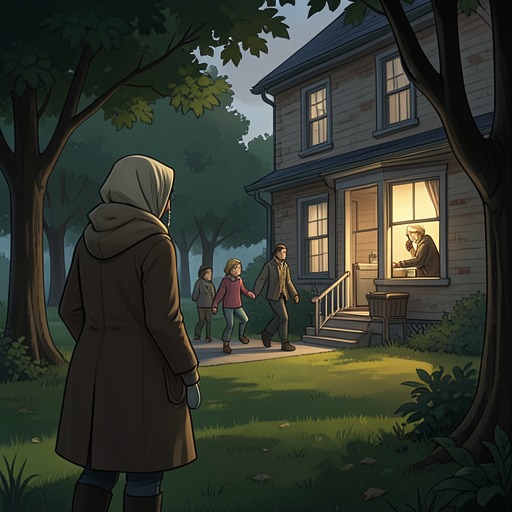
On another occasion, Ethan arrives at Anna’s home apologizing repeatedly. He explains that his father was yelling and that he needed to get out of the house. When Anna asks where his mother is, he says he does not know, then insists that she is fine. The darkened Russell house appears to Anna like a skull as Ethan glances back at it. That image is part of her narration and her apprehension; the concrete information Ethan gives is narrower: his father was yelling, he left, and he cannot say where his mother is.
These disclosures form a pattern of limited, qualified answers. Ethan acknowledges the anger in his household but minimizes its significance, and he expresses uncertainty about his mother while also declaring her safe. The contrast makes his reassurance difficult for Anna to accept, but the available exchanges do not confirm what has happened to his mother or establish how far Ethan understands it himself.
Connection with Anna and the Russells
Ethan’s visits create a connection between Anna and the Russells that becomes important when the adults dispute what Anna has seen. During a confrontation involving Alistair Russell and Val Norelli, Alistair explains that he had been looking for his son, not his wife. Anna admits that she had lied when she said no one had visited: she had received Jane Russell, and she and Jane had played chess. The admission clarifies why Alistair came looking for someone in Anna’s home, but it does not by itself settle the larger dispute over Jane’s identity or whereabouts.
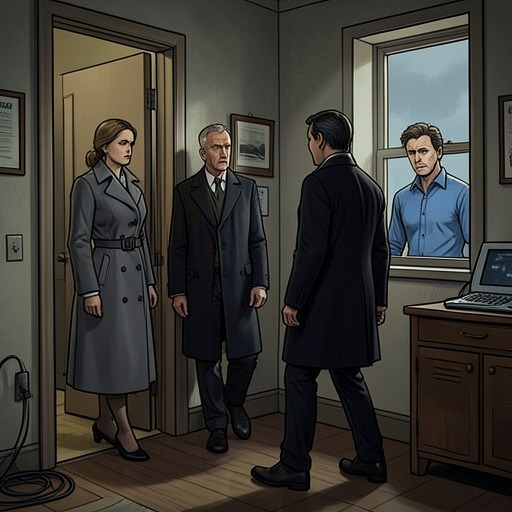
At the confrontation, Anna calls Ethan by name and tries to draw him into the exchange. He looks at her, then away. She tells him that the woman present is not his mother and asks him to say so, touching his shoulder as she does. His failure to answer leaves Anna without the confirmation she seeks. The scene shows the strain between her protective impulse toward Ethan and the pressure of asking a child to speak amid an adult confrontation; his silence cannot be treated as proof of either version.
Anna later considers why others might dismiss her account. She recalls seeing Jane with her family, seeing a locket containing Ethan’s picture, and seeing Jane send him to Anna’s home with a candle. These are details of Anna’s recollection and reasoning, not independent confirmation supplied by Ethan. In the same conversation with Bina, Anna argues that Alistair did not behave as though he had just stabbed anyone. Her interpretation of the household therefore rests partly on observed gestures and objects, and partly on her assessment of how people acted.
Silence, Suspicion, and Narrative Role
When Anna asks Ethan directly whether his mother is dead, he says nothing. She sees firelight reflected in his eyes, but his response remains unreadable; he mouths something she cannot hear. The question is more explicit than her earlier inquiries, yet the scene supplies no answer. Ethan’s silence intensifies the uncertainty rather than resolving it, and the unheard words prevent even Anna from establishing what he meant to say.
Later, Alistair calls Anna delusional while Ethan stares at the floor. Detective Little tells Ethan to go home and asks Alistair to remain. Anna interrupts, agrees that Alistair should stay, and raises her arm toward him with a paper in her hand. Ethan’s lowered gaze places him at the edge of the confrontation, but the moment does not reveal what he thinks of Anna’s accusation or what the paper proves.
Ethan’s narrative importance lies in the gap between what he discloses and what others need him to confirm. His homesickness and tears make his vulnerability visible; his account of his father’s temper gives Anna reason for concern; and his uncertainty about his mother supplies no conclusive answer. Because the story is filtered through Anna’s perceptions and suspicions, Ethan’s silences remain both emotionally consequential and evidentially ambiguous. He is not merely a witness to the conflict: his position as Alistair’s son is what draws his father to Anna’s home, while his inability or unwillingness to clarify events leaves Anna facing the limits of what she can know.